Stock water: planning supply, storage and delivery before summer
Water is the constraint that ends a grazing plan fastest. A system designed around supply, storage, delivery and monitoring keeps cattle watered through the hottest months and spreads grazing across the whole paddock.
- Author
- By Brampton Agriculture
- Published
Feed shortages develop over weeks. Water shortages develop over days, and sometimes overnight. A pump fails, a trough float sticks, a dam drops below the inlet, and a mob of cattle in a hot paddock is suddenly in trouble. Stock water deserves the same planning attention as pasture, and the time to give it that attention is before summer, not during it.
Demand first
Cattle drink more in hot weather, more when lactating, more on dry feed and more when the water itself is warm or poor quality. A system that comfortably meets demand in a mild month can fall short in a heatwave, when every animal in the paddock wants to drink in the same few hours. Planning starts with the peak demand of the largest mob the paddock will carry, on the hottest day, not the average.
Water quality is part of demand. Cattle drink less from water that is salty, muddy or fouled, and reduced intake shows up as reduced grazing and growth. Testing water sources, particularly bores and dams that have dropped, is a straightforward check that is often skipped.
Supply: where the water comes from
Every source has a failure mode. Dams depend on runoff and lose water to evaporation and seepage; a dam that looks full in spring can be unusable by late summer. Bores depend on pumps, power and the aquifer; a bore that has never been tested for yield can disappoint under sustained demand. Creeks and rivers depend on flow and may be regulated. Reticulated or piped supply depends on every joint and valve along the way.
A property with a single source for a paddock has a single point of failure. The practical question is what happens to the cattle in each paddock if its source fails, and how quickly they can be moved or supplied another way. The answer shapes where to invest.
Storage: the buffer
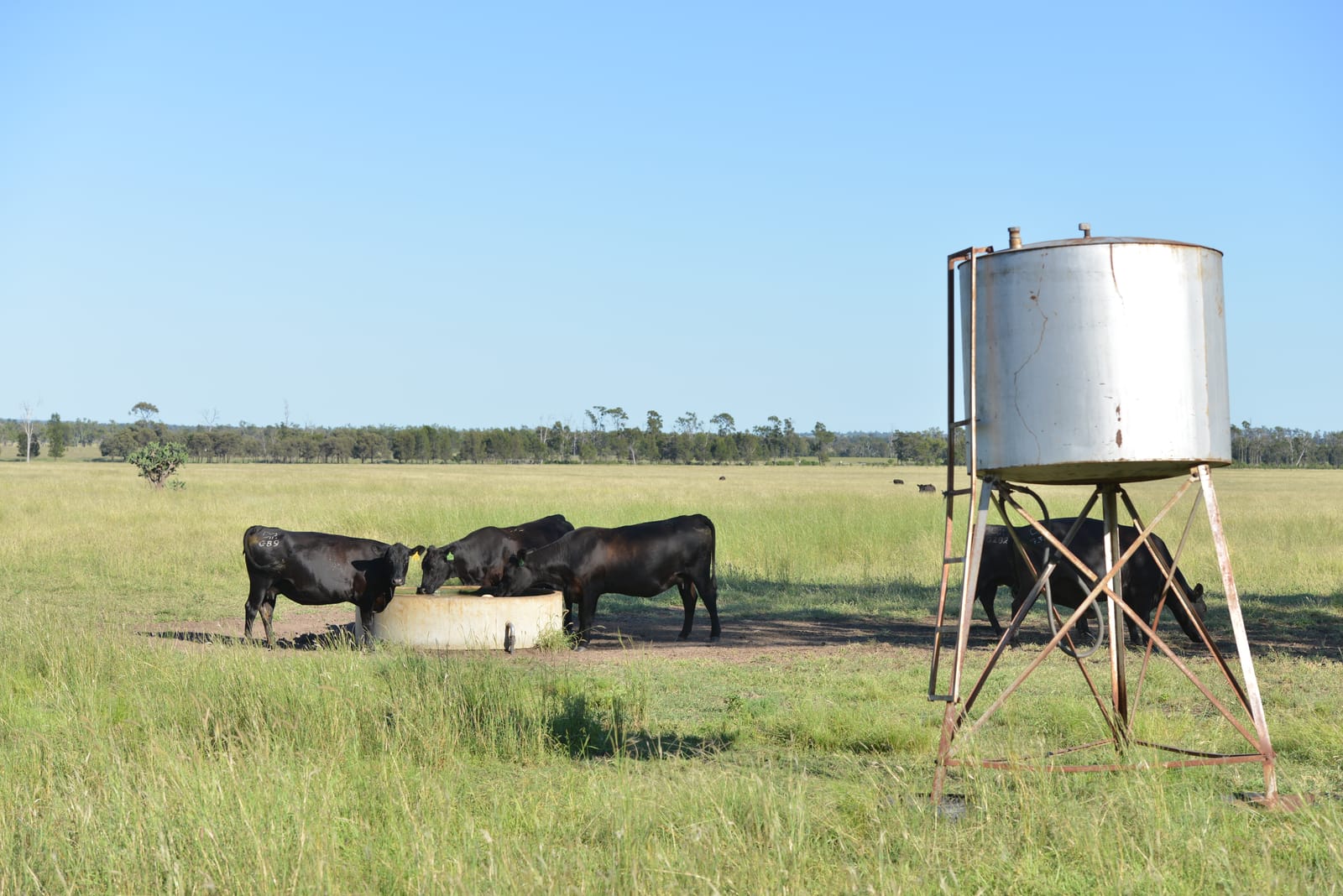
Storage is what turns an intermittent supply into a reliable one. A tank that holds several days of peak demand means a pump failure is an inconvenience rather than an emergency. Storage at height allows gravity delivery to troughs, which removes a pump from the daily system. The sizing question is how long the buffer needs to last: long enough to notice and fix a fault, including on a weekend.
Dams are storage as well as supply, and their reliability depends on depth and the catchment that feeds them. A deep dam with a small surface area loses less to evaporation than a shallow one holding the same volume. Fencing cattle out of dams and piping water to troughs protects water quality, reduces losses from pugging and fouling, and removes the risk of animals bogging in a drying dam.
Delivery: where cattle actually drink
Where the water is placed decides how the paddock is grazed. Cattle graze outward from water and return to it, so a paddock with a single water point at one end is grazed hard near the water and lightly at the far end. More water points, or a water point positioned to draw cattle into under-used country, spread grazing pressure without changing the stocking rate.
Trough design matters more than it looks. Enough trough length for the mob to drink without crowding, a flow rate that refills faster than the cattle empty it, a float valve that is protected from damage and a base that drains rather than turning to mud are the difference between a trough that works and one that generates problems. Troughs sited on a slight rise, away from shade trees that create stock camps, stay cleaner and keep cattle moving.
Monitoring: knowing before the cattle do
A water system fails quietly. The first sign is often cattle bellowing at an empty trough, by which time the problem may be a day old. Remote monitoring, from a simple tank level sensor to a full telemetry system, turns that into a notification on a phone. For a property with many water points or a manager who is not on site every day, monitoring is not a luxury; it is how the system becomes dependable.
Even without technology, a routine of checking water points on a fixed schedule, with the checks recorded, catches most problems before they become losses. The failure is usually not a lack of equipment but the absence of a routine.
Planning the investment
Water infrastructure is expensive and long-lived, so the plan matters. A useful sequence is:
- Map demand by paddock, for the largest mob on the hottest day.
- Audit each source for reliability, yield, quality and failure mode.
- Identify single points of failure and the paddocks exposed to them.
- Design storage to cover the realistic time to detect and fix a fault.
- Place water points to spread grazing and protect sensitive areas.
- Set up monitoring proportionate to the number of points and the people available.
Each step produces decisions that can be costed and prioritised, which is more useful than a general intention to improve water.
How this fits Brampton's approach
Reliable stock water is one of the practical improvements we consider on every property, because it supports both cattle welfare and better use of the pasture. We look at supply, storage, delivery and the ability to monitor the system together, as described in what we do. The way water placement and fencing interact is set out on Land and grazing.
Related reading
- Groundcover: the first thing to protect when the season turns dry
- Land improvement and grazing management
Sources
- Meat & Livestock Australia, More Beef from Pastures: Pasture utilisation
- Department of Climate Change, Energy, the Environment and Water, Water
- Meat & Livestock Australia, Tools and calculators
This is an explanatory article about stock water planning. Water extraction, dam construction and bore use are regulated; check the requirements that apply before building or modifying a system.